

 TAM (Treatments and Medicines) NHS Highland
Urine is normally sterile (it does not contain bacteria). A urine infection is caused by bacteria that get into the urine. Most are due to the bacteria that are commonly found in the bowel. They cause no harm in the bowel, but can cause infection in other parts of the body. These bacteria can lie near the anus (back passage) and travel up the urethra into the bladder. Here bacteria can multiply quickly, causing infection. Infection just affecting the bladder is called cystitis or a lower urinary tract infection (UTI), infection affecting the kidneys is called pyelonephritis or an upper UTI. Nearly 1 in 20 boys and more than 1 in 10 girls have at least one urine infection by the time they are 16 years old.
Patient information: Urinary Tract Infection (UTI) Prevention in Children (Paediatric Guidelines)

Warning
Understanding the urinary tract
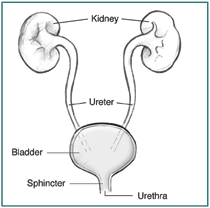
We have two kidneys, one on each side of the abdomen. They filter our blood and make urine. The urine passes down tube like structures called ureters into the bladder where it is stored. Urine is passed out through the urethra. A muscle, also called a sphincter controls the release of urine from the bladder by contracting or relaxing. Children who are not yet continent are not yet able to control this.
Erika N., Samuel N., Regula L.-E. Methods to prevent recurrent cystitis: Where's the evidence?. Swiss Med. Wkly. 2017;147(Supplement 222):9S. Cited in: Embase at http://ovidsp.ovid.com/ovidweb.cgi?T=JS&PAGE=reference&D=emed18&NEWS=N&AN=627024049. Accessed June 19, 2020.
Schwenger EM, Tejani AM, Loewen PS. Probiotics for preventing urinary tract infections in adults and children. Cochrane Database Syst Rev. 2015;(12):CD008772. doi:10.1002/14651858.CD008772.pub2, 10.1002/14651858.CD008772.pub2
Tewary K, Narchi H. Recurrent urinary tract infections in children: Preventive interventions other than prophylactic antibiotics. World j. methodol.. 2015;5(2):13-9. doi:10.5662/wjm.v5.i2.13, 10.5662/wjm.v5.i2.13
Williams G, Craig JC. Prevention of recurrent urinary tract infection in children. CurrOpin Infect Dis. 2009;22(1):72-6. doi:10.1097/QCO.0b013e328320a885, 10.1097/QCO.0b013e328320a885
Persad S., Watermeyer S., Griffiths A., Cherian B., Evans J. Association between urinary tract infection and postmicturition wiping habit. Acta ObstetGynecol Scand. 2006;85(11):1395-1396. Cited in: Embase at http://ovidsp.ovid.com/ovidweb.cgi?T=JS&PAGE=reference&D=emed9&NEWS=N&AN=44985649. Accessed June 19, 2020.
Specialty Doctor in Paediatrics with Renal Interest: Dr Janaki Vedarajan- Contact via secretary or email- janaki.vedarajan@nhs.scot
Paediatric Renal Secretary: Paula Graham, Raigmore Hospital- 01463 701342 (from outside the hospital). Extension 7542 (from within the hospital). Mon-Fri 9-5pm
| Abbreviation | Meaning |
| BP | Blood Pressure |
| DMSA | dimercapto succinic acid (radioisotope study) |
| eGFR | estimated Glomerular Filtration Rate |
| ESBL | extended spectrum beta lactamase Ecoli (resistant Ecoli) |
| MAG3 | mercaptoacetyltriglycerine (radioisotope used in renal imaging) |
| MCUG | Micturating Cystourethrogram -involves catheterisation and injecting urograffin (iodone product) into the bladder. |
| UTI | Urinary Tract Infection |