

 The Queen Elizabeth National Spinal Injuries Unit
It is important to regularly stretch any tight joints and muscles as having a good range of movement will improve your comfort and your ability to participate in functional activities. Your physiotherapist will guide you on an appropriate stretching programme. You may need someone to assist you to stretch effectively and your physiotherapist can train them in how to do this.
Maintaining Physical Health

Warning
After a spinal cord injury, it is important to maintain your physical health. The team at the Unit will support you in this throughout your journey.
After spinal cord injury, you will likely use your body in a different way to how you did before due to muscle weakness and/or changes in sensation and muscle tone. For example, if you use a wheelchair then your shoulders will now be used throughout the day for transfers, personal care, and wheelchair mobility. As a result, you can be at increased risk of overuse injury. It is therefore important that you look after your joints to maintain your level of function.
If you notice any new pain or tightness in your joints, think about relative rest (i.e. avoid non-essential use) until the symptoms settle. If your pain does not resolve with relative rest, arrange a physiotherapy review. This can normally be done through self-referral to your local physiotherapy department or alternatively through your GP.
The recommendations for standing after spinal cord injury is to stand for a minimum of 30 to 60 minutes, three to five times a week. This can be cumulative time (i.e. in small chunks) rather than one long session. Standing may be active standing or walking if you are able to do this. If your legs are too weak to stand, you may be able to use standing frame or tilt table. Standing frames/tilt tables can be provided for use at home if you have the space, can use it independently, or have someone that can be trained to assist you.
Regular standing will help to maintain your range of movement, boost your circulation, improve bladder and bowel drainage, minimise bone density loss and relieve pressure over the areas normally in contact with the wheelchair seat.
Speak to your spinal unit physiotherapist about how best to integrate standing into your week.
It is important to maintain a healthy diet for bladder and bowel regulation, skin health and weight management. Gaining weight may make it more difficult for you to transfer, walk, or engage in personal care. In addition, weight gain may mean that your splints and wheelchair no longer fit you.
Balancing a healthy diet with physical activity is the most effective form of weight management. Further information on healthy eating can be found at:
Physical activity is any bodily movement produced by your muscles that requires energy expenditure and refers to all movement during leisure time, for transport to get to and from places, or as part of your work. It is important for everyone to be physically active but this can appear to be more challenging after spinal cord injury.
It is common for people with spinal cord injury to have reduced physical activity levels, particularly those who depend on a wheelchair for mobility. This can increase the risk of cardiovascular disease, deconditioning of the muscles, and weight gain however these risks can be managed by regular participation in physical activity.
Guidance on physical activity levels after spinal cord injury can be found in the image below and further information on physical activity after spinal cord injury can be found at:
 Physical Activity after a spinal cord injury - WheelPower
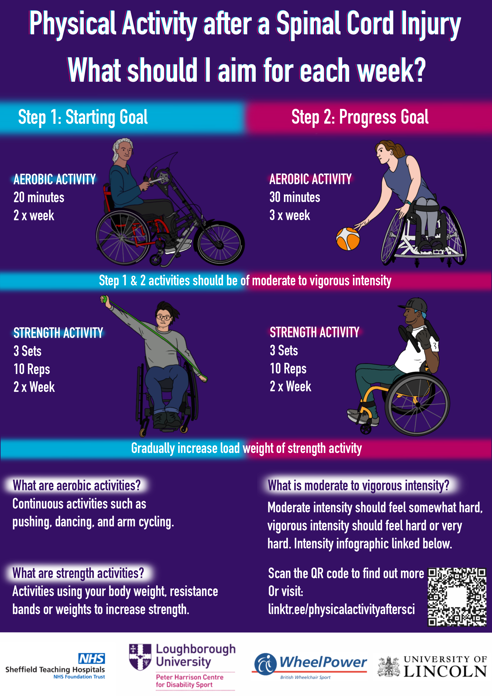
Some people may be interested in attending a gym or sports club but there are also many opportunities for physical activity in your own home. There are now a number of wheelchair / adaptive exercise videos available online, including those produced by WheelPower. You can discuss your opportunities for physical activity with your physiotherapist or the WheelPower physical activity advisor.