Warning

Pressure Area Care

Following a spinal cord injury you may no longer receive the messages to your brain letting you know that you need to change your position.  You may not be aware that your shoes are too tight and a blister is forming.  You might not know that your bottom is going numb and that you should change your position.  These are things that you would have previously done without thinking.

During your stay in the spinal injuries unit you will learn how to manage your own pressure area care.  This will enable you to know how long your skin can tolerate being in the same position without pressure damage occurring, how to recognise subtle changes early and to take appropriate action if damage occurs. For those who require assistance with personal care we will teach you how to direct your own care and have the confidence to ask those delivering your care to keep you informed about the condition of your skin and pressure areas.

Skin tolerance is built up slowly over a period of time.  There is a spinal pressure ulcer prevention protocol, which allows you to safely achieve sleeping on each side overnight without needing to change your position and being able to spend all day up in your chair.

The spinal pressure ulcer prevention protocol aims to safely increase your time spent in your wheelchair without having to return to bed to pressure relieve, thus enabling  you to sit all day in your wheelchair and return to work, study, driving and recreational activities you previously enjoyed.

Skin tolerance is defined as the amount of time you can lie or sit on the same skin surface without your skin becoming damaged. 

Skin damage is a non-blanching mark that does not fade within 15 minutes

What is a pressure ulcer?

A pressure ulcer is an area of damaged skin and/or tissue. It usually starts with the skin changing colour e.g. appearing redder or darker than usual, this is known as non-blanching pressure damage. You will learn about this during your stay. If left untreated, a blister or open wound can develop. If no preventative action is taken this can result in a deep hole in the skin with exposure of underlying tissue and even bone. 

Staff in the spinal injuries unit will refer to pressure ulcers using a grading score called the Scottish Adaption of the European Pressure Ulcer Advisory Panel (EPUAP) Pressure Ulcer Classification Tool.  It is far better to avoid pressure ulcers from happening because they can take a long time to heal. If pressure ulcers are left untreated they can lead to other complications and can be life threatening.

What areas are at risk?

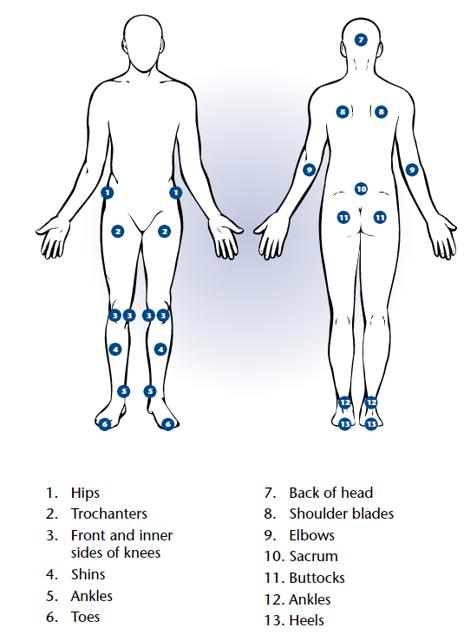
Everywhere is at risk but particularly skin areas over bony prominences, e.g. hips, knees, elbows, lower back, buttocks etc.

What Causes Pressure Sores and How Can I Prevent Them?

Pressure

The skin is an organ, the largest organ in the body and as an organ it requires a good healthy blood supply to keep it nourished and to remove waste products in the form of sweat. When we apply pressure to the skin for a prolonged period of time the blood supply to that area is reduced, this reduced the amount of oxygen and nutrition reaching that area causing the skin to deteriorate and die which leads to pressure damage. 

Pressure

Pressure on the skin means blood cannot get to it. When you take away the pressure the skin becomes pink from the blood supply returning to the tissues. Usually skin colour returns to normal after 15-20 minutes. If skin colour does not return to normal after this time, this means that damage has been done to the underlying tissues.

Shearing

This is the sliding of skin over bone e.g. sliding down the bed or dragging your bottom against the wheel when transferring. Damage occurs to the underlying tissue causing damage to the skin. You will work closely with your physiotherapist to develop safe transfer techniques.  You may be given aids to assist with safe transfers. Your ability to transfer yourself from different surfaces will depend on your level of spinal cord injury and ability.

Friction

This is rubbing of one surface against another e.g. ankles or knees rubbing together. Spasms can produce friction which may result in tissue damage particularly to ankles and heels. Your hands can become damaged due to having to propel your wheelchair, consider wearing gloves to protect your hands. The wheelchair you are provided with is bespoke to your needs, be mindful that if you gain weight over the years your wheels have the potential to rub on your skin causing friction.

Deep Tissue Damage

This is damage that occurs to deep tissue, think of when you have fallen and banged your knee, the underlying tissue and blood supply to the area has been compromised but it can take a few days for the discolouration (bruise) to develop, and when it does you suddenly remember the fall you had.  We can see this a few days after your injury, your skin your skin on admission to the spinal injuries unit appears undamaged but a few days later discolouration becomes visible, this is known as suspected deep tissue damage.  We are unable to grade this accurately until the discoloured area has resolved.  Experienced spinal nurses will be able to determine if there is underlying damage or if the discoloured area will fade over time.

Excess Moisture

The most likely causes are sweat, urine or faeces. All of these are waste products which have harmful toxins that work like acids when in contact with the skin. You need to wash and dry your skin thoroughly. Be mindful that in hot weather you may produce more sweat particularly around your groin area and this can cause moisture associated skin damage, which in turn can cause thrush. Treatment for thrush such as antifungal creams may prescribed to treat this.

Anaemia

This means there are fewer red blood cells to carry oxygen to the tissues. You should eat a healthy diet rich in iron (e.g. spinach, broccoli, breakfast cereals or nuts). In severe cases medical staff may prescribe Iron tablets. 

Underweight or Overweight

If you are underweight you have less padding around the bony parts and if you are overweight you will be placing additional pressure onto these bony areas.  If overweight you may also have a tendency to produce more perspiration especially when spending long periods of time in your wheelchair. We would encourage you to eat a healthy diet and drink plenty of water. We would recommend you try to drink 2 litres of water each day unless your doctor tells you otherwise.

Infection

Infection causes an increase in temperature and sweating which increases moisture.  You should check your skin more often when you have an infection. You may need to increase how often you turn or reduce the time sitting in your chair if you have an infection

Steroids

Long term use of topical steroids can make the skin thin and as such more prone to breakdown and pressure damage.  You should be mindful of the potential risk if topical steroids are prescribed.

Nutrition

Your diet can affect the healing process. Protein promotes wound healing (e.g. red meat, milk, eggs.) Vitamin C (e.g. oranges, tomatoes) promotes the skin’s elasticity or suppleness. Make sure you include these in your diet.  A poor diet lacking in these nutrients can also make the skin more prone to pressure damage.

Smoking

Smoking narrows blood vessels, which reduces the circulation to the skin making the skin more at risk. There is also the risk of burns from hot ash. We would advise you to try and stop smoking.

Advice and support from this can be given whilst in the spinal injuries unit.

Wheelchair, cushions, shower chair/commode

Your wheelchair cushion gives you postural support and promotes even weight distribution, therefore helping to protect the skin on your bottom. However, sitting the wrong way can cause pressure sores. The areas at risk are sitting bones, base of spine, and the back of heels.

How can I reduce the risk of pressure damage?

  • You will be taught how to relieve pressure regularly and review pressure areas before getting up and on return to bed.
  • You will be taught how to avoid knocking your toes, feet and ankles during transfers.
  • You will be provided with a cushion bespoke to your needs.  It is essential that your cushion is on your wheelchair the right way round and that the cushion cover is on correctly.
  • Cushions should be checked prior to mobilising.
  • If a gel cushion in use, the gel the gel in the cushion should be redistributed prior to mobilising.
  • If a roho cushion in use the pressures should be checked and be correct prior to mobilising
  • You will be given contact information for your local wheelchair provider should you need to be re-assessed
  • You will also be provided with a padded shower chair to protect your pressure areas while showering

Hot and Cold

Your spinal cord injury can affect your temperature awareness, This means you will be more at risk from damage caused from heat for example sitting to close to a radiator or open fire and cold for example not realising you need to layer up when the temperatures drop, your body will not let you know that you are cold. You will have to be consciously aware of environmental risks and take appropriate steps to mitigate the risks to you. Often the paralysed body takes on the environmental temperature due to an inability to shiver or sweat normally.

You will learn how to manage these risks during your stay in the spinal injuries unit.

These are some tips to reduce the risk of skin breakdown:

  • Check water temperature on an area of skin with normal sensation.
  • Do not hold hot drinks between your knees.
  • Do not rest hot food on your chest or knees.
  • If hot drinks are spilt on you immediately apply a towel soaked in cold water to cool the area down.
  • Do not use a hot water bottle, heated car seats or electric blankets.
  • Keep a safe distance from fires, radiators and hot water pipes.
  • Dress appropriately for the temperature of your environment.
  • In warm weather use a high factor sun cream and do not stay out in the sun too long.
  • If you are lying on a sun lounger place your wheelchair in the shade as the metal frame can get very hot.
  • Smoking can cause burns and reduces blood supply to the skin it is recommended that you try to give this up. Support with this will be offered from the smoking cessation team whilst in the spinal unit.
  • Remember to dress for the weather if cold outside layer up it is always easier to take layers off than to add on. Your body will not be able to tell you that your feet are freezing or your hands are cold.  It can then take a long time to get your body back to normal temperature when you come back into the warmth.

Clothing

Many items of clothing and accessories can increase pressure on your skin.

You will learn about the risks associated with different clothing whilst in the spinal injuries unit.  However be reassured that you will be able to return to your normal style of clothing.  You just need to give consideration to a few things.

Trousers and Denims

  • Are easier to put on and sit in for long periods if they are looser at the waist, hips and crotch area.
  • Look at the seams, buttons, pockets, studs, do they have rough edges? Remember you will be sitting on these all day.  Pockets, studs and buttons can easily be removed.  Your Occupational Therapist will be able to give you advice on clothing.
  • Avoid putting keys or loose change in pockets or holding them between your legs. You will not feel the damage they are causing and could easily forget they are there.


Skirts

  • You may need to go up a size around your waist and need a longer length so you feel more comfortable while sitting in your chair.
  • Look at the zips buttons seams it may be easier to avoid these or move them to the side so you are not sitting on them.

Shoes

  • Should be one size larger than normal to allow for swelling of your ankles. This tend to result from sitting in your wheelchair for long periods of time
  • Avoid tying them too tightly
  • Like everyone new shoes can always cause friction be extra careful when wearing new shoes to check your feet carefully when removing them.

Underwear

  • Whilst in the spinal injuries unit you will not wear underwear.  This is to allow you pressure areas to get used to long periods of time in the same position without the addition of seems and tight clothing.
  • You will return to wearing underwear, if you wish.  We would advise you to choose underwear that is going to be comfortable next to your skin and not have any rough seems or edges. 
  • It is advisable to avoid nylon.

Socks

  • To avoid pressure damage from thick seams we would recommend you to wear socks inside out.

Accessories

  • Be careful that belts and buckles do not dig into your skin.  Remember you may not feel pressure damage occurring so check your skin on return to bed.
  • If you require assistance with washing and dressing those delivering the care should have short nails and no watches or jewellery on.  These items can cause damage to your skin.


Overall you have to actively look after your skin. During you stay in the spinal injuries unit you will receive education from the dedicated spinal team on how to prevent pressure damage, recognise early when damage is occurring and the steps to take if damage has occurred. If you require assistance with personal care you will be given the skills to enable you to direct your own care. Pressure areas are checked when changing position in bed and before getting up in the morning and on return to bed. You will be shown how to use long handled mirror to check the areas of skin you cannot see. You could also take a picture of the area with your own mobile phone or ask a friend or family member to do this for you.  Unfortunately staff in the spinal injuries unit will not be able to take a picture for you. Hospital pictures can only be taken by medical Illustrations.   Increased spasm or excessive sweating can be an indication of pressure damage. You will learn how to position yourself correctly in your chair.

If your skin is damaged (e.g. redness, swelling, bruising, blistering or broken) it’s important that you relieve pressure to the area. This means staying in bed to ensure the damaged area of skin is completely pressure free. If the area of damage is not affected by sitting in your chair then you can continue to mobilise.

Pressure sores can take a short time to form and a long time to heal. The good news is you can prevent pressure sores if you find them quickly and take immediate action. Unfortunately if you ignore them then they can lead to further complications, including infection and can in extreme circumstances be life threatening.


Skin Tolerance

Skin tolerance is the length of time you can lie or sit on one area without getting a red mark. Everyone’s skin tolerance is different. It is important to know what your skin tolerance is.

If lying or sitting on a different surface than usual, your skin tolerance time may be different so if you are trying a new surface for the first time, check your skin more frequently.

How often should the skin be checked?

Whilst in hospital specialist spinal nurses will check your skin and encourage you to check your own skin every time you change position in bed and every time you get up and on return to bed. This is to establish what your skin tolerance is.

This is the policy followed in the spinal injuries unit to build up your skin tolerance:-

  1. Everyone commence turning at 2 hourly intervals – side/side turns should be encouraged to ensure the sacral and buttock areas are kept free from pressure and allow reperfusion whilst in bed. These areas are more prone to pressure damage when in your wheelchair.


  1. If each hip/side remains free from pressure damage after 2 hourly turns, turns can be increased to 3 hourly side/side.


  1. If each hip remains free from pressure damage after 3 hourly turns, turns can be increased to 4 hourly side/side.


  1. Once turning 4 hourly side/ side is achieved the following steps are taken:


    • 4 hourly side/side turns – repeat this twice, and if the skin remains free of pressure damage progress to -
    • 5 hourly side / side turns - repeat this twice, and if the skin remains free of pressure damage progress to -
    • 6 hourly side / side turns - repeat this twice, and if the skin remains free of pressure damage progress to -
    • 7 hourly side / side turns - repeat this twice and if the skin remains free of pressure damage progress to -
    • 8 hourly side / side turns - repeat this twice and if the skin remains free of pressure damage increase until 10 hourly side / side turns are achieved.


The aim is to achieve turn times twice, on each side, with no pressure damage occurring. Turn times will only be increased as above when the skin remains intact, showing no signs of pressure damage at all.

For example, if you are in your wheelchair during the day it will take 4 nights to achieve 8 hourly turns safely. If positioned on the right side on night 1 for 8 hours, then on night 2 you will be positioned on the left side, and this would be repeated for night 3 and 4.  This approach allows skin tolerance to be built up safely.  If any damage is noted at all then you should not be positioned on the side with damage until the damage has resolved. You will will have to incorporate time on your back whilst sleeping.

Following this process allows you to have the confidence to sleep in the same position without the need to be turned overnight. Which not only leads to a broken nights sleep but also potential need for carers coming into your home. 

By the time you go home you should know what your skin tolerance is. Routinely you should check your skin twice a day:

  • Once before getting up in the morning
  • Once before going to bed at night

However, if you have any skin problems you need to check your skin more often. Any broken, red or bruised areas need to be kept totally pressure free until they heal completely.

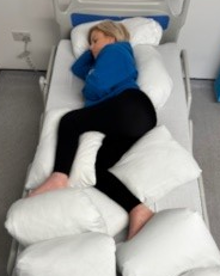
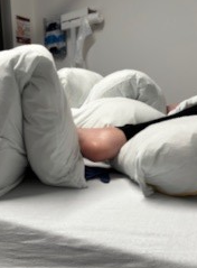
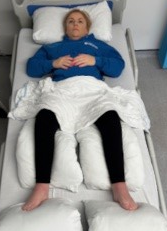
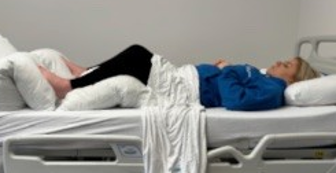
How do I position myself in bed?

If your skin tolerance is 8 hours that means you should turn every 8 hours. If it is 6 hours then you should turn every 6 hours etc. 

When lying on your side, the risk areas are:
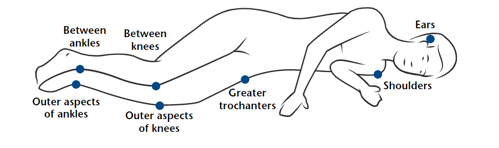
 

Patient on side in bed                         Patient in bed with heels free of presure

When lying on your back, the risk areas are:
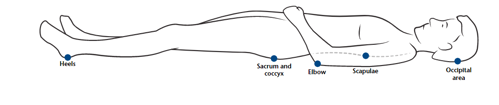
 

                 Patient in bed on back          Patient in bed secured on back

When lying face down, the risk areas are:



Using pillows at risk areas can help in relieving pressure. Lying face down is also good for straightening your hips and knees and can reduce leg spasms.

How can I relieve pressure in my wheelchair?

When sitting in your chair, it is important that you relieve pressure regularly. You can do this in a number of ways.

Lifting buttocks from chair

In order to do this you need to have good arm strength. Apply brakes and push up either from the armrests or wheels until your buttocks are free of the chair. Count to 20 slowly and then come back down again. Do this every 15 minutes.
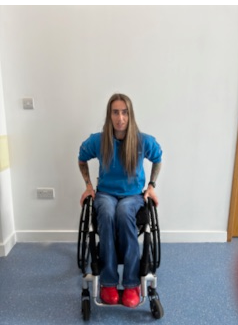
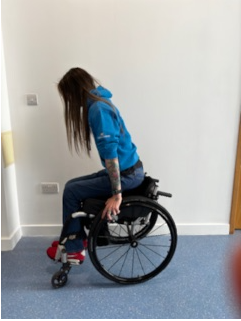
Preparing to lift from chair    Patient rising form chair side view

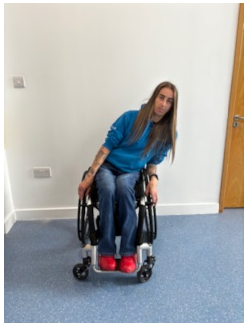
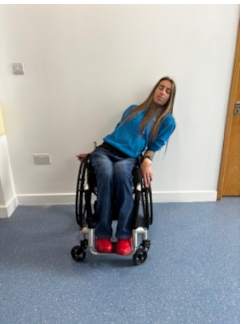
Leaning from side to side

If you do not have good arm strength then going from side to side is an alternative. Apply brakes, hook your arm around back of chair and then lean to opposite side that takes the pressure off that side of the buttock. Count to 20 slowly and repeat on the other side.
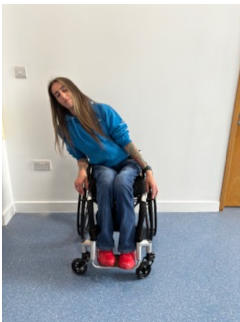
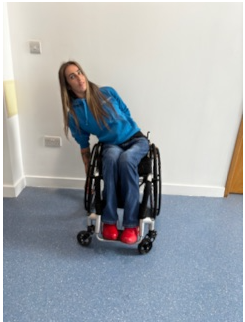
Leaning to the left 1       Leaning to the left 2

Leaning to the right 1       Leaning to the right 2

Tilting forward

Tilting forward is another effective method but again you need good arm and balance control unless there is someone to help you. Apply brakes, bend forward (moving your chest towards your knees), balancing by leaning your arms on your upper thighs or wheelchair. This lifts the weight of the buttocks off the chair seat.
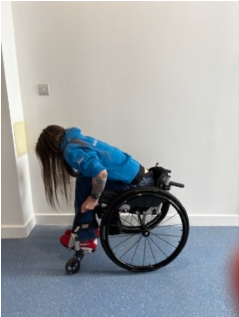
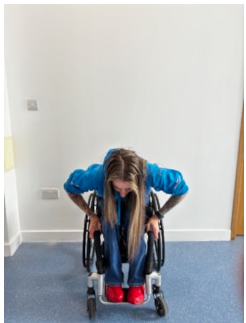
Patient tilting forward 1    Patient bending in chair

When do I need bed rest?

If a red mark develops over your hips, buttocks, or lower back, stay off the affected area. This means staying in bed until it the damage has resolved. If the pressure damage is caught early and fades within 30 minutes the time spent on that side should remain static until skin tolerance is achieved. If pressure damage takes more than 30 minutes to fade, you should not lie on that side. If tissue damage does not fade, for example, if there is a red area on the left hip then then you should only lie on the right side and the back.

Whilst in the spinal unit, if pressure damage is unresolved then a therapy mattress would be requested. Turns onto the unaffected pressure areas do not need to be reduced to 2 hourly because a therapy mattress has a higher pressure relieving property than a normal mattress.  When home you may already have a therapy mattress. If not you can contact your district nurse to have one ordered for home delivery or you may be offered an overlay mattress with greater pressure relieving properties than your current mattress.

Turn times on a therapy mattress should be reduced by half of what they were. For example,  if someone has pressure damage on the left side and was turning 8 hourly, turns would be changed to 4 hourly right side and back with the left side remaining pressure free.

When the pressure damage has healed and 8 hourly skin tolerance has been achieved on a therapy mattress, you would be transferred onto a foam mattress.  Turns are then reduced to 2 hourly and built up as before in steps 1-4 of building skin tolerance up whilst in bed. Intervals between turns should always be reduced to 2 hourly when changing from a mattress with greater pressure relieving properties to one with lesser pressure relieving properties.

What do I do when skin has healed?

If there has been a skin problem requiring a period of rest in bed then once it has completely healed you can gradually get up. If you are in any doubt please contact your spinal liaison nurse for guidance on how to manage this process safely and effectively without compromising your skin.

Guidelines for mobilisation (getting up) following bed rest

When your pressure areas have completely healed you can begin the process of mobilising in your wheelchair again.  We take this slowly accessing the pressure areas on return to bed and prior to mobilising.

The following is a guide to mobilising following a period of bedrest:-

  • When mobilising following a period of bed rest for pressure damage and you have  been on bedrest for 2 days or less, no change is required to your sitting time (if the cause has been alleviated, consider cushions clothing etc). If you have been on bedrest for 7 days or less, the sitting time is reduced to 1 hour and built up by 30 minutes per day. If you have been on bed rest for 8 days or more, then you should start mobilising for 15 mins sessions only. 


  • If you have been on bedrest for a non-pressure related problem, for example you have had the flu an infection or problems with your bowels, and have been on bedrest for 2 days or less, no change is required to your sitting time. If they have been on bed rest for 7 days or less your sitting time is halved and increased by 1 hour per day. If they have been on bedrest for 8 days or more, the sitting time starts at 1 hour and is increased by 30 minutes per day. If you have been on bed rest for 2 weeks or more, you should start sitting up for 30 minutes.


Review you pressure areas before mobilising and on return to bed.

Day 1 Up for 15 mins x 2
Day 2 Up for 30 mins x 2
Day 3 Up for 45 mins x 2
Day 4 Up for 1 hr x 2
Day 5 Up for 1 hr 30 mins x 2
Day 6 Up for 2 hrs x 2
Day 7 Up for 2 hrs 30 mins x 2
Day 8 Up for 3 hrs x 2
Day 9 Up for 3 hrs 30 mins x 2
Day 10 Up for 4hrs x 2

Once you get to four hours twice daily you may find it easier to have one session sitting in the middle of the day e.g.

Day 11 Up for 4hrs 30 mins x 1
Day 12 Up for 4hrs 30 mins x 1
Day 13 Up for 5hrs x 1
Day 14 Up for 5hrs x 1
Day 15 Up for 5hrs 30 mins x 1
Day 16 Up for 5hrs 30 mins x 1
Day 17 Up for 6hrs x 1
Day 18 Up for 6hrs x 1
Day 19 Up for 7hrs x1
Day 20 Up for 7hrs x1
Day 21 Up for 8hrs x1
Day 22 Up for 8hrs x1
  • Check your pressure areas every morning and every night!
  • Use or a mirror or take a picture using your mobile phone for areas that you can’t be seen.
  • Take action immediately! When you detect a red mark or even suspect pressure damage is forming and sitting in your wheelchair will put pressure on the area of concern, go onto bed rest and ensure the affected area remains pressure free.  You can then mobilise when resolved.
  • Whilst in the spinal unit you will be supported with decision making regarding pressure area care.  Once discharged if you have any concerns please contact your spinal liaison nurse or district nurse for advice.


Editorial Information

Last reviewed: 30/09/2024

Next review date: 30/09/2028

Author(s): Editorial Group QENSIU .

Version: V1

Co-Author(s): louise.cownie@nhs.scot , campbell.culley2@nhs.scot , mary.hannah@nhs.scot , susan.gilhespie2@nhs.scot , claire.lincoln2@nhs.scot .

Reviewer name(s): Mary Hannah.